


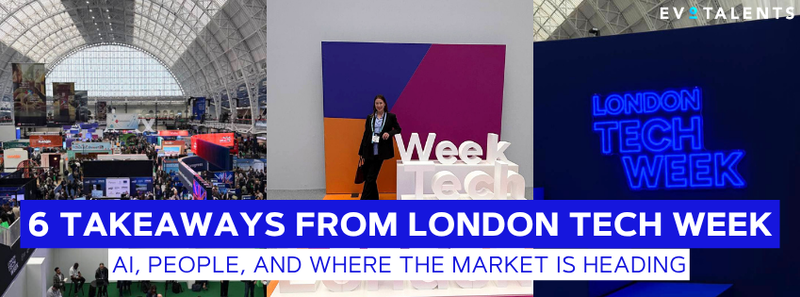
Every June, London becomes the centre of the global technology world: London Tech Week brings together thousands of founders, investors, and technology leaders from across the globe. I am Elena Volk, founder and CEO of EvoTalents. Our IT recruiting agency follows where the talent and technology markets are heading, so this year I went to see it firsthand.
I spent most of my time not in the AI arena sessions, but in conversations with founders, angel investors, and leadership teams from companies across different countries. Each conversation ran 30 to 40 minutes: starting with business and ending somewhere much further out: children, philanthropy, the question of why any of this is worth building. Here is what stayed with me.
1. The Shift from Reactive to Proactive
One session covered how AI is changing the way support teams operate, and the speaker framed it through a very precise image. Even Ukrainian support teams (who keep working through air raid alerts) operate reactively: a customer calls, an agent responds, a customer writes, an agent resolves. The entire system is built around answering requests.
Voice AI agents can already replace that function. But what is more interesting than the replacement is the direction: these agents can work proactively. They do not wait for a question. They anticipate it, deliver information before the customer ever calls, and take action without human involvement.
I spoke separately with a founder building exactly these kinds of voice agents: they book doctor appointments, reserve services, make calls on the customer's behalf. They pick up immediately, no queue. In the UK, this problem is particularly acute: a phone call is often the only way to reach a specialist, and many people simply give up along the way. His data shows how many potential customers businesses lose simply because getting through is difficult or slow.
In recruiting, this same shift is already underway. The operational tasks that currently take up the bulk of the working day are being automated. Not in theory. Now.
2. AI and Cognitive Impact
The talk that stayed with me most was one that seemed, at first, far removed from technology: how AI affects the way we think and speak. The speaker, a very charismatic woman, approached it through her own experience. She said plainly: she has stopped writing. She dictates everything. Two or three sentences in any language, and she is already switching to voice input. And she noticed the consequence: she has started forgetting words mid-presentation.
I listened and caught myself doing the same. Short sentence: I will type it. Anything longer, I will most likely dictate. That is already my normal, and I suspect it is not only mine.
After the talk, I had a conversation with a teacher. We spoke about how people learn and retain information. Part of that process is built on motor memory: writing in school, looking at text, repeating. Knowledge was consolidated through that physical process. If the next generation simply stops writing and typing altogether, just speaking into a microphone, how will that affect the way they think and learn? No answer yet. But I think the market will respond: new approaches and startups will emerge to work with this.
3. AI Is Literally Everywhere
Two or three years ago, at conferences like this, it was all about blockchain and crypto. This time I saw none of that. Every company, every project, every presentation I encountered was built around AI.
The most vivid example: a Korean company that sells tea. They set up a machine that scans your face, tongue, and finger. Based on that, it generates a health report and recommends which of five tea varieties suits you best. I went through the scan myself. It looks like an attraction, but the idea behind it is real: personalised selection through AI analysis. Instead of choosing by taste, you receive a recommendation matched to your specific state.
Thinking about it more broadly: skincare matched to your skin type, a coach or learning programme after a short assessment, a service bundle tailored to your personality. This is already happening across different niches and will reach most industries in time. If you are developing a product or exploring a new direction, it is worth asking: where does AI-driven personalisation fit here?
4. Impact First
I may have simply been lucky with the people I met, but this turned out to be the most personal takeaway. In an entire week, I never once heard: "we are building this to make money." Almost everyone I spoke with was thinking in terms of "what problem does this solve" and "what value does this create for people."
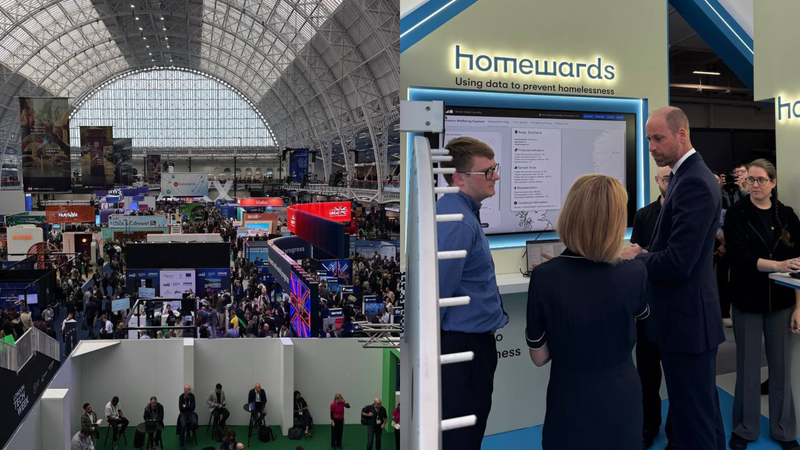
One of the clearest examples: a founder in his mid-seventies who had led major companies for decades. He is now building his own AI startup. We spoke at length, and in the way he describes his product it was clear: at 75, you build what matters. I also spent time with the team from Prince William's foundation, Homewards, a programme to end homelessness across the UK. They came to London Tech Week to launch the Homelessness Data Lab, a collaboration with Salesforce and LandAid that uses data to identify people at risk before they lose their home. The idea: if homelessness can be predicted, it can be prevented. Prince William himself spoke in the AI Arena at the launch. Their goal is to make homelessness rare, brief and unrepeated. It connects directly to the first section of this article: the same shift from reactive to proactive, but applied where the stakes are much higher.
Money matters, but when impact becomes the first question rather than a byproduct, business gets built differently. And the people worth building something serious with think exactly that way.
5. The Entrepreneurial Mindset Inside a Company
This is the takeaway most directly relevant to what we do in recruiting. I spoke with the founder of an IT company from Romania. We talked about how AI is changing how teams work, and he described something I recognise in our own work: a gap between people who execute operational steps and those who see the full process.
He was talking about developers, but the same applies to recruiters and sourcers. The operational tasks that used to fill most of the working day are now being automated: reviewing profiles, initial outreach, collecting candidate information. What is not being automated: seeing a problem before it becomes critical, understanding where a process breaks down, taking responsibility for outcomes rather than for steps completed.
He called this the product owner mindset. Every person inside a company becomes an entrepreneur of their own process: finds the problem, delivers the solution, owns the result. If you have not yet felt this pressure in your own role, it is already on its way and it will reach everyone. In recruiting, people with this mindset have already been given a new name. But that is a separate conversation.
6. Cybersecurity and the Question DeepSeek Raised
Security in AI ran through most conversations at the conference. But the sharpest question came up specifically around DeepSeek.
It is significantly cheaper than Anthropic and OpenAI. My own AI agent running on DeepSeek costs under 10 cents a day and works well. But what came up at the conference is worth understanding in broader terms: DeepSeek was trained in China, on Chinese data, with Chinese values built into its foundations. When you use it, your data effectively goes there.
For a personal agent handling your own tasks, that is one question. For a product processing client or company data, it is an entirely different situation. The UK and the US are already thinking about this at the government level. Choosing a model is no longer just a technical decision: it is a question of who you trust with your data and your clients' data. Worth asking that question consciously before you start building.
And Finally: Live Connections Still Matter More Than Sessions
I missed most of the conference sessions. I spent nearly all my time in conversations. And in a few days I received invitations to different countries, ideas for collaborations, and connections that are already turning into something real.
Through all the automation, all the voice agents and AI personalisation: live connection remains the source of everything real. A conversation that lasted 40 minutes and went far beyond business gives more than a full day of passive session attendance.
If you have the opportunity to attend an event like this and spend your time in genuine conversations rather than just sessions: do it. It remains one of the most valuable investments of time there is.
Let's talk about how 2026 is changing recruiting in your company
If you are thinking about how automation will affect your hiring, or already navigating the changes and want to talk to someone in the process: book a 30-minute call.


